THE REALITY OF DRUG TESTING AT USEF

I am writing this in response to the article in the Fall 2024 issue of the US Equestrian magazine on Equine Anti-doping. I’ve been on the receiving end of USEF’s ” professional, fair, and respectful treatment” when my horse failed a drug test. It is quite different from the picture painted in the article.

USEF says they exist to enforce fair sport and rules. That their process is fair for everyone and is in place to protect our rights. Well guess what? That’s a lie.

The truth is the drugs and medications department exists to generate revenue. It is a bureaucratic machine. We must submit to it even when it is unfair.

USEF is never wrong. If your horse fails a drug test, it is 100% your fault. If you question this, and show them their own guidelines that permit leniency, or have legitimate concerns that the failed drug test was due to outside contamination, you are getting in the way of the machine. The consequences are severe.

The ’process’ is window dressing for a department that exists only to extract money from USEF members. If you refuse to comply with this shake down, you will be destroyed. USEF will disparage your character, smear you to make it appear you intentionally drugged your horse, fine you into oblivion, and if you still won’t pay, ban you from sport for life.

I played their game for over 6 months. I kept waiting for someone with common sense to step in and resolve this in a fair and professional manner. Instead, it kept escalating.

My horse tested positive for Cetirizine (Zyrtec) at a therapeutic level, according to USEF. It was in the urine, not the blood. I never gave this drug to my horse. I explained this. It starts out with, yes, we understand you didn’t drug your horse. Next is, if you want to try and prove that, we will retest the sample but that will cost you at least another $1,000. At this point I didn’t trust their labs or the way the sample was handled, so in addition to the exorbitant retest cost, I declined.

The compromise offer was an $1,800 fine. Their ‘compassion’ was to offer me a payment plan. I continued to resist, and this led to them revealing a ‘reconsideration’ where I could ask again for leniency. I was told it was hopeless before I even presented my request.

Reconsideration was more lip service, just giving them more time to try to convince me that it was only my perception that this was unfair, not that it actually was. Their own guidelines allow for them not to penalize at all. I was bewildered that an entire section of the guidelines was being completely ignored.

The reconsideration was rejected, and I was ordered to admit guilt and pay the fine.  I would not.

Months went by. The process was unclear which seemed intentional. There was little communication. From the few interactions I did have, I discovered that their standard for guilt is the legal doctrine of strict liability.  That means intent doesn’t matter in determining accountability.  Even though I exercised due care (I didn’t drug my horse) I can still be held responsible.

The hearing was scheduled. This is more like a trial where they send multiple vets and lawyers in to testify against you to ensure that they win.  USEF winning is a foregone conclusion based on strict liability.

No lawyer would represent me, as the USEF had a slam dunk case. It was now crystal clear there was no way out of this massive penalty and forced admission of guilt. USEF knows this but doesn’t reveal it, unless you hold out, and go all the way to a hearing.

USEF knew at worst this was unintentional contamination yet they came at me with 175 pages of evidence like we were in some adversarial death struggle. It was completely unnecessary and yet they chose to do it. Why?

Why would they treat their members like this? As if USEF members are common criminals with no moral compass.

My horse failed a drug test at a small show, in an open class of no consequence. He wasn’t even registered to earn points or participate in any year end awards. There was no incentive to cheat.

I’ve been competing for nearly 40 years and none of my horses ever failed a drug test. I guess I spent decades building trust so I could cheat in an open dressage class that doesn’t count for anything. USEF thinks this makes sense.

Ultimately the USEF won their case against me and the penalties were assessed. If I want to show in rated competition, I must pay.

I reflected on the torturous journey I took to get to this crossroad. They stressed me out to the point that I couldn’t sleep, eat, or concentrate on my work. I was scared to lose my ability to compete because it was a big part of my life and the only way to get it back was to comply with their demands.

I finally had what for me was the perfect horse.  I was excited to try for higher level competition. Now it looked like those goals would have to die.

It is one thing to say you have morals and standards, and another thing when you are staring straight at the end of a lifelong dream to stand up for yourself and your morals and standards. It would have been easy to pay the fine and go on with my life. However, I can’t do something I know is wrong even if it appears to destroy my life’s work.

I thought that since I had revealed how broken this process was, it would be a starting point to get it fixed. Unfortunately, nobody at the USEF or USDF, or even others this has happened to, has any interest in doing this. Calls and emails went unanswered. My position is not popular nor can it be used to inspire change.

Since I’ve been banned, I’ve had to come up with alternate competition plans. It wasn’t easy but I put together a show season for myself this year.

It was hard to write this and relive what happened. I gave up my show career to stick up for myself. I’ve exposed the reality of how failed drug tests are really handled. That there is no process, and the window dressing they call the process is stacked against the membership. There is no way to defend yourself. You pay or you give up USEF recognized shows.

USEF needs to follow the guidelines as written, or do away with this false process.

The reality is this: a failed drug test can simply generate a letter and a bill, sent to the USEF member.  There is no need for a department of people to gaslight the membership that this is fair or that it’s even a process.

A lot of effort is put into creating this illusion. Perhaps that effort should be redirected into something more positive for the membership.


SOMETHING WONDERFUL

I never thought much about cars. I bought my first and only car, a 1990 Mustang, because I thought it would be a fun car. I never thought about selling it, never really wanted to sell it, figured I’d have it forever. Overall, I didn’t think much about it. I’m not a car person, I’m a horse person. If something needed to be thought about, it was horse related.

I spent a lot of money fixing that car. I’d rather spend the money on the car I had, than buy a new one. When I looked at new cars, I always thought mine was better.left side

It occurred to me, every once in a while, to take care of my car. I would take it in for extensive detailing, and I had myself a new car again.

When I started my own business 4 years ago, I didn’t drive as much and it seemed the Mustang was just as good as any other car for getting around town for errands and the occasional long trip.

I bought new trucks in the meantime, but the car was a fixture. I decided I’d rather spend my money on horses, and since they were expensive, I figured I’d never have enough of what I considered ‘left over’ for a new car. And since I didn’t want one it was all working out.

Then something that I would classify as strange occurred. An odd turn of events over a couple of months. I’m not sure why this happened, but it became something wonderful. Perhaps not that exciting to most people, not life altering, but as it flowed along, I took great notice of it. An unknown force somehow decided something was needed in my life. I didn’t invite it in. This thing that can’t be classified as thing compelled me to write a story.

It began when my new truck needed some major recall work done. I was planning a long haul with my horses to California in a week and it didn’t seem possible the work could get done before I left. The recall was so extensive I thought it best to find a way. A dealer in Seattle was found who could do the work. It would be a 2 hour trip and I’d have to leave the truck at least overnight, so they offered me a rental car.

When the rental agency picked me up at the dealership, there was me and one other lady needing a rental. They said they had a minivan and a Dodge Challenger. A minivan sounded like a nightmare to me, since I had to drive home 2 hours, so I spoke right up and said ‘dibs’ on the car. The other lady said that was fine with her.

My Mustang, being 30 years old, didn’t have much in the way of driver comforts so when I took my seat in the yellow V6 Dodge Challenger, I was completely freaked out by all the high tech controls, the fact that the air conditioning worked, and it started by pressing a button, not by turning a key. I was actually kind of scared to drive it.

I sat in the rental lot for about 5 minutes trying to orient myself. Once out on the open road, I pressed the accelerator and that thing took off like a rocket. I laughed and laughed every time I sped up, or passed another car. I mean, I literally could not stop laughing and smiling. Over a car.

After I got it home, I couldn’t stay away from it. I drove it around enjoying the thrill of driving this car I previously never even knew existed. I was surprised by how much fun I could have with a car.

2019 new car ytellow

When I had to drive it back to the rental agency I was sad.

Once there, the rental agent mentioned that I had rented the Challenger with the smaller engine, but they also rented the one with the bigger engine, the Hemi. I told him that I hoped I had a chance to rent this Hemi. I was actually looking forward to that day, which at that point who knew if it was even coming.

On the drive home, I decided I was overly impressed by a new car and I’m not used to all the modern fun things a new car can do. What do I need a new car for? And how can I part with my Mustang? I told myself I shouldn’t waste money on things I don’t need.

I took my California road trip and all was well. Even during the trip, which was all horse focused and very exhausting, I continued to find myself thinking about this Hemi.

It made sense, as I had been taking courses on business development, mostly focused on changing your mindset and thinking about what you really want, not what you think you can get.

I learned that thoughts are things, and that if you can imagine it in your mind, a way to make it reality is there. The nice thing about thoughts is they are free, and nobody else has to know about them but you. I kept imagining driving this Hemi and how much fun it would be.

A few weeks later, my truck needed more work done. Immediately I thought, my dreams, they came true!! I called the Seattle dealership and said I wanted them to look at my truck and by the way could I rent the Hemi.

Then the rental company dashed my dreams by telling me they couldn’t hold cars nor guarantee any of these Hemis would be around. I said well if I have to drive a minivan 100 miles home, I might have to stab myself with a fork. They found no humor in my situation.

I begged the service department at the dealership to get me this Hemi. It took several phone calls and the best I could get was “we’ll see what we can do.”

Then another manifestation;  when I dropped off my truck the rental agency came to pick me up – in the Hemi I was going to rent.

This car was black, and because it was a Hemi it was a little louder and throatier in the idle, and it had paddle shifters on the steering wheel, shifting it into manual mode gave the driver even more power.

It didn’t take me long to figure all that out and I was bee boppin’ and scattin’ all the way home on the freeway, and all over the long straight country roads.  I would punch the gas and have my head hit the headrest going from 0 to 60 in less than 6 seconds. I still did not understand why this was so appealing, and why I was spending all my time thinking about cars when I never had before.

dream car

When I finally had to park it for the night, and brought the keys in, I noticed my first name on a tag attached to the key chain. Not my last name, my first name. As if the car already belonged to me. For some reason this blew my mind.

rental car sign from god

I was even more sad when this one had to go back. After I dropped it off, I knew my destiny was to have one of these beautiful cars.

Then my mind started to struggle with the idea. My Mustang had always been there. A very reliable car and yes an inanimate object, but I was attached to it anyway.

It was hard to act.  I knew in order to get the Dodge Challenger Hemi, the Mustang would have to be sold. I thought since I really want this car, that will be easy. It wasn’t. It took me 2 weeks to work up the motivation to clean up the Mustang and place the sales ad.

Several weeks went by.  I was trying to figure out how to pay for the new car. The Mustang would sell but not nearly enough to pay for the Challenger. Many times I dismissed the idea to buy it. My horses are very expensive, and I am always saving for some upcoming large purchase. I was giving myself a choice, to either have a horse or a car.

But then I thought, what if? That’s another question my business training told me to ask.  What if, and why choose? Why not both? All I have to do is find a way to pay for it. How? Getting more clients, offering a valuable service that people want to pay for. My usual old way of thinking, is you can’t have everything you want. I had to let that go.

It is absolutely true you can’t have everything you want. Something must be sacrificed for something else. In this case, free time is sacrificed for work. I knew the answer; get on the hustle and get more clients. The decision was simple, and I understood the sacrifice. When you are working for something you want, and you are doing work that is helping people, it doesn’t seem like work at all.

Opportunities may not come in the order you expect them to, but you still have to act, to make the choice and know that the end result will be as you see it. So the Mustang didn’t sell, but the 2019 Dodge Challenger showed up. It made an appearance during an internet search, with a price so low I thought the engine must be missing.

It was confirmed that the car was real, and it had all the features I wanted. It was also 150 miles away. The price was so unbelievable, I felt that this was it.

I was leaving on another long trip with my horses in less than 3 days. I had to act fast. The dealership told me they wouldn’t hold the car, I needed to get down there quick. I found a way to pay for the car, I found a ride, and in 2 days I was on my way to pick it up.

On the drive to pick it up the Challenger someone called me and offered me a low price for the Mustang. He told me he was going to ‘part it out’. I was conflicted. Was this the opportunity to sell the car and make all the decisions end, or should I go with my gut that told me I could get more for the car than this guy was offering and I needed to find it a home that wouldn’t take it apart?

I turned the offer down, and drove home in the Challenger. Then I started to think I might have buyer remorse. It was a big purchase and maybe I made a huge mistake. There was no time to ponder any of this. I drove it a day or two, then left for another 2 weeks.

gettin the keys

The Mustang was on ebay and was getting low ball offers I kept turning down. One person spoke with me on the phone. He wanted all kinds of details, and told me he and his dad used to restore cars. His dad ran into some trouble and was experiencing hard times. He told me that he wanted to buy the car and restore it with his dad as a gift to him.  I knew I had found the best home for my car. We were able to make the deal.

I came back from my California trip and a few days later the Mustang was loaded onto a truck and shipped to Kansas.

The way you think about the world affects your results. What if I had stuck with my original ‘normal’ thinking.  That spending money on a car is a waste, it should be saved. That you can’t think in terms of having it all, and realizing your dreams.

But there’s a flip side. What if by keeping my old car, I prevented another person from realizing their dream? In my mind, I knew I wanted the Dodge Challenger. I was emotionally attached to wanting it, I kept thinking about it until I found a way, then I found the car. Was it the other side, the person who really wanted my car, that caused these thoughts to be in my head in the first place?

Who am I to decide that someone else can’t afford, or doesn’t need, something they truly want? My old car may help a person turn their life around for the better.

All this happened because of a yellow V6 Challenger that made me smile. Or possibly because someone else thought about a 1990 Mustang.

He continues to keep me updated. Here she is with new headlights:

mustang with new owner


I’ve had my new car 2 months and I’m still loving it. I find errands to run. I love to drive fast. There is no buyer remorse. This was destiny!

Jeffie and car


CHOOSING AN ACCOUNTING PROFESSIONAL FOR YOUR SMALL BUSINESS

Every business needs an accountant. Small startups are usually run by one person who has great ideas but needs help executing them. It’s important to get a quality team together at the beginning to support the business and set it up for success. A savvy business owner understands that investing in quality accounting services will provide a good return, boosting the business to the next level.

You may be tempted to do everything yourself. If you have any kind of business training, or are an organized person generally, this might be acceptable. But if the business is growing fast and you are spending all your time serving your customers, the needs of YOUR business may be neglected.

Serving your clients, or creating your products, should be a priority. However if you aren’t generating invoices, then cash isn’t coming in. If you don’t have time to review the vendor bills, and wonder if you have the cash in your account to cover your expenses, you may damage your relationship with your vendors.

The firm or individual you choose should care that your business grows and succeeds.  Hiring the right accountant from the start can make a huge difference. The following tips will help you choose the professional that is the best fit for your business.

  1. Don’t think you can’t afford it. Depending on the size of your business, and the amount of work you are willing to do yourself, initial bookkeeping setups can be as low as a few hundred dollars. A CPA or bookkeeper’s office should be happy to take your call and answer a few questions free of charge. This should at least lead to action steps you can take on your own if you choose to do so.
  2. Don’t make cost the primary decision maker. Cheaper isn’t always better. You may be tempted to hire the least expensive professional you can, but that can be a huge mistake. The fees may be low because the service isn’t top quality. The accountant you choose should be considered a partner in your business success. They should be interested enough in your business to ask questions to understand it, and offer tax planning and perhaps marketing tips to help you succeed.
  3. Be sure you have a thorough understanding of the fee. Make sure your accountant clearly states what they will do for you and how much it will cost. If you feel the fee exceeds your budget, ask if you can do some of the work yourself. If your accountant advises against it, ask them why. They should be looking out for your best interests, regardless of the fee.
  4. Ask if there are any fee discounts. Accounting and tax preparation is largely a referral based business, and some professionals offer referral discounts. For example if you refer a friend to your accountant and that person or business becomes a client, the accountant may give you a partially discounted fee.
  5. Don’t be shy to question anything you don’t understand. While your accountant is a professional and isn’t in the business of teaching you to become one, it is still important to understand the work that’s being done. A good accountant is happy to answer all questions and explain their work.

You should demand top quality service from any accountant you choose. Your phone calls and emails should be answered promptly. All questions should be answered to your satisfaction. Even if your accountant only does work for you annually (such as prepare your tax return) they should check in with you at least every few months to see how things are going.

During the year, tax laws may change.  You will want to know if these changes affect your business. If they do, it is crucial to have time to do something about it before year end. It is the job of the professional you hire to keep up with changes in the financial and regulatory landscape, so you can focus on running your business.

FREE TICKETS TO CLINTON ANDERSON’S WALKABOUT TOUR IN LAS VEGAS JULY 19 AND 20, 2014

As a Downunder Horsemanship Club member, I received a limited number of extra tickets to this tour stop. Clinton puts on a great show. I guarantee you will learn something that you can put to use right away with your own horses.

I was very skeptical when I went to my first tour a year ago. But after 2 days of watching him work with the horses (and the people) I knew this was something special. Although it is focused toward Western riding, the basics are the same for any horse.

More information can be found at this link: http://clintonanderson.com/Home/Events

Please contact me if you’re interested. I also have a discount code for the hotel that I will provide with the ticket.

I also have an extra ticket to an exclusive Members Only party on Saturday night. If you are interested, please let me know when requesting the ticket. Here is additional information on that event:

No Worries Vegas Club Party Clinton is rolling out the red carpet for members at the No Worries Vegas Walkabout Tour July 19th and 20th at the South Point Equestrian & Event Center. Part of the V.I.P. treatment includes an exclusive party. You’ve heard us talking about it for months, and now we’re ready to share some details. Here’s the rundown: 

When: The party will take place Saturday evening at 6:30 and will conclude at 7:30.

Where: All of the action will be in Exhibit Hall A that’s located near the arena.

 If you love to get free stuff and want to mingle with club members and the Downunder Horsemanship team, this is your scene. There will be cash bars and finger foods to munch on while you visit and mix around the room. Upon entering the party, you’ll be given tickets to enter into drawings for training kits, equipment and a ton of really cool stuff. We have enough prizes gathered to draw a winner every minute of the party. Prizes will be in the form of Downunder Horsemanship product and sponsor gifts, and our sponsors have been very, very generous!

The tour should be a lot of fun and I look forward to meeting my fellow horsemen!

TIPS FOR DEALING WITH SALES OR PAYROLL TAX AUDITS

When business owners hear the word audit, it seems to stir up a variety of unpleasant emotions. These include fear, dread, annoyance, sometimes even anger.

While it’s true we must comply with audit requests, there are times when the auditor may ask for inappropriate documents. There have also been cases when an auditor presents him or herself in an unprofessional manner. The head of the accounting department must determine if the auditor is a competent professional and can be trusted with sensitive company documents.

Recently, I was involved in a payroll audit. It started out normally enough, with the auditor sending a request list to the client.

The client contacted me concerned about some of the items requested. The client did not want to send electronic copies to the auditor using email, as it didn’t seem secure.

Normally, auditors have a secure portal where documents can be uploaded. This is a common practice, however in this case it wasn’t clear this was an option.  In the end, the client requested that the auditor come to the business and perform the audit. That way, the records could remain on site.

That was when things went bad. The auditor showed up and was unrecognizable as a professional person due to his unkempt dress. Although he provided identification, the first impression was very bad.

The audit proceeded relatively normally, until he asked if he could make copies of the payroll records to take with him and review later. In addition, he seemed unfamiliar with payroll and the various reconciling items on the payroll register.

The accounting manager was very concerned.  However, she was afraid that if she denied these requests or made any trouble, the company might be punished by the entity conducting the audit. I advised her that the actions of the auditor were completely inappropriate and she should ask him to leave the premises immediately.

After the auditor had gone, I advised the accounting manager to contact his supervisor and explain the situation. I stressed that doing so immediately was very important, to show that the company was willing to cooperate, but they had concerns with the process.

The situation was resolved without further incident. A new auditor was assigned, and another date set to complete the audit.

Below is a list of tips that will help you experience a smooth audit:

  1. Always speak to the auditor on the phone regarding the requests. This will help you get to know the person you will be working with, and any concerns you have with their demeanor can be dealt with prior to the start of the audit;
  2. If the auditor is requesting electronic documents, find out if they have a secure portal where the documents can be uploaded. If not, an audit on site is preferred;
  3. If the auditor is requesting sensitive documents (like payroll records) be sure they cite the code which gives them the authority to do so. If security is breached, then they are responsible for any negative outcomes;
  4. When the auditor comes to your business, make sure they have proper identification. If they provide something that doesn’t satisfy you, you are well within your rights to call the main office and express your concerns;
  5. If the auditor requests something that makes you uncomfortable, go with that feeling. For example, if they want to copy records to take with them, that is a huge security risk. Any requests you feel are unusual should be questioned;
  6. Finally, if the auditor is acting inappropriately in any way, ask them to leave the premises. Immediately communicate with the main auditing office and explain your actions.

Generally, auditors are very understanding and sensitive to the time involved in conducting the audit. They want to make it as easy on the business as possible.

Your first responsibility is to the company you work for, and the employees of that company. The auditor needs to show respect for the business, and your time. If you don’t think that is the case, you must speak up with confidence and authority.


HOW CLINTON ANDERSON’S METHOD HELPED ME CORRECT A BEHAVIOR PROBLEM WITH MY DRESSAGE HORSE

DCIM100MEDIA


I was reminded once again of the hazards of equestrian activities a few days ago. My horse fell on me.

She had been giving me some trouble for a few days and it was getting progressively worse.  I was familiar with this bad behavior, as she had done it before. It had been over 6 months since the last incident so I thought I had trained it out of her.

The problem was her reaction to the leg and spur when I asked for vertical flexion (giving in the poll). She does find it difficult, but instead of resisting, she slams on the brakes and starts violently throwing her head around.  I ride her in a thin loose ring snaffle, but when she has resistance on her mind, she’s so strong she can rip the reins out of my hands.

On this day, she stopped, and started throwing her head around. I bent her nose to my boot and she started to go sideways.  I could feel her losing balance. I thought some sense of self-preservation would kick in and she would either stop or go forward. Instead, she pulled her head down and sideways, her front leg went straight out, and down she went.

It felt like slow motion, and she initially went down straight, like a camel. It gave me time to get my feet out of the stirrups. By the time she was all the way on the ground, she rolled slightly sideways onto my leg, but I was able to pull it free.

Her ongoing difficulties caused me to search for answers in unusual places. I’m most familiar with dressage training, but none of the techniques I tried on her worked.

I found the answers at a Clinton Anderson demonstration. He refers to his training techniques as The Method. I found the groundwork very effective and have been working my horse using his Method for about a year.

I was glad for it on this day. I didn’t want to get back on, so I did various groundwork exercises. After she was relaxed and listening, I got back on asked her to go forward on a loose rein. She complied and I ended the session.

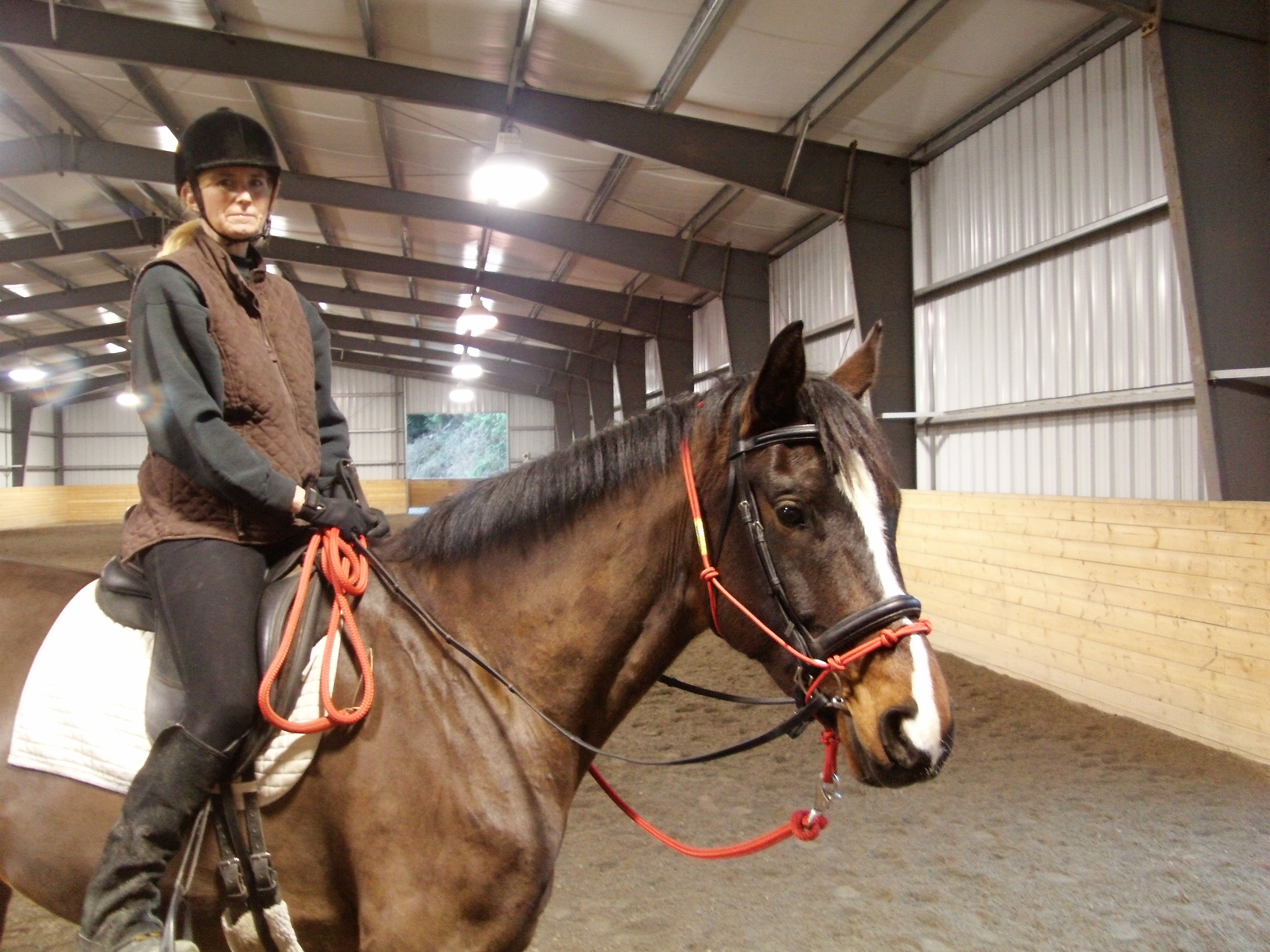
I needed a way to translate the ground work to under saddle. The next day I asked my husband to help me. I put the rope halter on over her bridle, got on, and had him do the groundwork. She is trained to follow the lead, so whenever she got stuck, he would pull her head to the inside and point with his arm in the direction I wanted to go. If she didn’t respond, he would swing the stick.

This worked great, as long as she knew he had the line. The minute he took it off, she stopped.

I decided to leave the line on the halter and hold it myself. That did the trick. If she stopped and refused to move, I would pull her head slightly to the inside, and she would follow the lead.

After a few minutes, she was pretty solid and I could catch her before she stopped and essentially prevent the behavior.

The video shows the second day. I had my husband help me again. You can see at these certain points in the video where she stops and I work through a few different things. Initially I thought if I yanked the line it might help her focus, but I could see that after about a minute it wasn’t working.  Pulling her head to the inside was the most effective. Although the stopping never went away entirely, at least I had a way to deal with it.

Most people would say a horse that reacts badly to the leg should be made to go forward. I would say that too.  I normally would swallow my fear, put the reins in one hand, and either use a long jumping bat or spank her with the long rope. The problem is she shuts down, and if she is irritated with the bat or the long rope, she will either buck or swing her head and pull the reins out of my hands. The head swinging is what caused her to fall before.

I’ve learned that sometimes being patient and non-confrontational is the best way to handle her. Each horse is different, and if I do something that doesn’t work, I have to admit that I was wrong and try something else.

I included another video to demonstrate some of the groundwork.

https://www.youtube.com/watch?v=xq0sB5eXVZ0 Liesl – riding with rope halter and 14 ‘ lead

https://www.youtube.com/watch?v=noS8ivJ0I-U Justine – groundwork exercises

DON’T MAKE THIS MISTAKE ON A SALES CALL

I almost always take cold sales calls. You never know when the person calling may have just what you are looking for but don’t know it yet.

I don’t mind taking five to ten minutes out of my day to learn about a new product. I’m always looking for something that will enhance the efficiency of my business.

On a recent sales call that I initiated, I hoped to learn more about the product I was interested in. Unfortunately the salesperson spent most of the time talking. He talked and talked and talked, telling me how wonderful the product was, how they were a leader in the industry, why they were better than the competitors, and why he understood my problems.

As a result I spent the entire hour long call somewhat bored and disinterested. By the end of the call I no longer had any interest in the product. It may very well have been a product that was useful to me. However, I was so put off by the sales call I didn’t even want to spend any more of my time on it.

What was the mistake the salesperson made?

He failed to ask me any questions. By the end of the call, he knew next to nothing about me, the company I worked for, what our problems were, or how his company was going to solve them.

As a fairly engaged and interested potential customer, the salesperson’s job should have been easy. If he had tried to find out more about me and my company, the sales cycle would have continued. Instead it was stopped short.

You are in the business of satisfying the wants and needs of your customers. You won’t know what they are unless you ask. The more information you have about your potential customer, the better you will be able to tailor your message to target their problems and show how your product or service will solve them and make their lives better.

The easiest way to keep that customer interested is to ask them questions, and really listen to the answers.  If you are doing all the talking on the sales call, it is preventing you from finding out what your customer needs.

Here are a few questions you should ask your potential customer:

  1. What initially made you interested in our product or service?
  2. What are your biggest problems that you think our product or service can solve?
  3. What would an ideal solution look like, in your opinion?

The sale may not happen on the first call. Engage the customer by asking questions. They will welcome additional contact and information. If your solution works for them, they will be happy, and likely refer you to others.  This enhances your network and reach, building a positive reputation within your target market.

THE BEST (AND EASIEST) WAY TO MARKET YOUR SERVICES

In a service business, no matter who you are dealing with, your first question should always be this:  “How can I make this person’s life easier?” This will go a long way in differentiating your service business from all the others.

How can you over-deliver?  Train yourself to provide so much value that your client can’t help but say “wow!”

For example, any accounting firm can prepare taxes. What makes yours special? Your clients need to know what makes you best suited to understand their pain points.

You never want to use your client’s goodwill with you for the sole purpose of increasing the fees of your business colleagues through referrals. This is particularly bad if they offer absolutely nothing of value to your client.  This attitude will eventually destroy your business.

Your client should always know that if they have a question or problem and they pick up the phone and call you, that you will have a solution. They know your network is extensive and filled with quality experts. Even if you don’t have the expertise to solve the problem, you can tap your network for the answer.

And your network is only happy to oblige, because you have surrounded yourself with people just like you, people that always over deliver, many times without expecting anything in return.

But I have to make money, you say? Yes that is true. Part of making money is establishing yourself as a trusted expert. This takes time and repeated exposure to your target market.  One of the easiest ways to do this is for others to market for you. Satisfied clients are only happy to talk about you and recommend you to others.

This is the value you receive when you do extra work for your client, not expecting payment for every phone call or meeting.

Remind yourself of all you have to offer when setting fees for your services. Quote your prices to reflect your value, and you will be more than happy to assist your clients with the extras.

Clients shouldn’t have to put up with bad service.  I don’t tolerate that in my life and I try to help people learn not to tolerate it in theirs. As a business person, your time is valuable. Don’t waste it on a poor service provider. If a service provider is doing something that bothers you, tell them. If they don’t fix it, ask yourself how much they really care about you, your business, and your success.


DRESSAGE CAN’T BE TAUGHT – IT MUST BE LEARNED

This is specific to dressage, as I am a dressage rider.

I’m not aiming this post at an absolute beginner, who would require teaching on basic horsemanship and position skills.

This is directed at intermediate level riders. These are riders with enough skill to control their horses and deal with most behavior issues.

If you are afraid of your horse, or are just starting out, yes you need a trainer. But if you are trying to learn the nuances of dressage, unfortunately it is a learned skill. Nobody can teach it to you.

I find that teaching someone how to ‘ride dressage’ is difficult if not impossible. The reason is that skilled dressage trainers rely on feel and timing to train their horses to respond. Feel and timing can only be learned by doing, including hours and hours of repetition.  Since we are dealing with an animal, this limits the amount of time you can spend in the saddle developing these skills.

I read a book called Mastery by Robert Greene. In the book, he discusses how much practice it takes to truly master a skill. Some say 10,000 hours, others say up to 20,000 hours. So if you only ride one horse five days a week, that’s 240 hours a year at best. Two horses brings you closer to 500 hours. So for horse riding, at that clip, it would take 41 years to master. Of course nobody ever masters dressage, it’s impossible. But it’s easier to do if you have balance, feel, and timing, and you’ll only get that by riding.

So many people are looking for some magic dressage success formula, like if you just uncover the secret key, you’ll be a success, win at the shows, and be able to train horses with ease. Or they think they just need a fancier horse and then they will be on their way.

The truth is, yes, all of that will help. Trainers will help you see things differently, and find more effective ways to train the movements. Talented horses find the movements easier and learn them faster. But so many people forget that they are also part of the equation. If you don’t ride well, the horse will never reach its potential.

I go out to the barn every day and ride without fail. I even had three horses for a while. I never wanted three horses, I even told myself it was impossible to ride three horses and keep a day job.

But I managed to do it because I saw the bigger picture. That third horse was increasing my time in the saddle. Hour by hour, day by day, weeks to week and month to month, I was adding to my knowledge base. That’s why even when I was tired, it was cold out, or I just plain didn’t feel like it, I still rode. Being excellent at something is quite a reward, no matter what sacrifices you need to make.

The problem when you rely on a trainer is that it shifts your attention from you getting better, to finding a solution outside of yourself to get better. This will never work out.

Whenever I relied on trainers, it took something away from me. I find dressage to be unique to each person, everyone has their own flair. It might be right, or wrong, that’s really not the point. The point is it works for them. If you want to reach the pinnacle of achievement you may have to let go of some of your wrong habits. Whenever a dressage trainer would dismantle my entire system, I would get upset. Then I would try to embrace their vision for my riding. I eventually learned that was a huge mistake. I had to be smart enough to know what to take, what to discard, and what simply wasn’t going to work, right or wrong. I have to work so much on my own I can’t allow my training to become frozen because I’m trying so hard to be right.

I have position problems and I’m grateful for the many people that have taken the time to relentlessly tell me how wrong I am over a period of days until it’s drilled into my head. I can take that back home and keep it up. Yes, it’s hard without someone harping on you every day, but you have to ultimately take responsibility for improving, and it’s not just practice, but ‘perfect practice’ The fact that I could be potentially wasting my time learning a bad habit is enough to scare me straight.

A recent clinic drove this concept home. I was told that yes I needed to practice sitting up straight and not leaning back, but there was no way I would get enough repetitions just practicing in the saddle. I was told that when I was at work I was never to lean back in my chair, to sit on the edge of it always straight. That doesn’t seem difficult until you try to do it. I was exhausted after the first hour. But I kept my awareness up. Every once in a while I have to relax and lean back in my chair, but it feels like a very strange thing to do now.

The reward for all of this hard work and sacrifice is to become truly excellent at something, to master it. I love to go ride now, because I know each day I have a plan, I have the skills to get there, and I’m not afraid to try new things or make mistakes. That makes every day a pleasure, and I’m grateful for the chance to try.

TAX DEADLINES – DON’T LET THEM STRESS YOU OUT!

With tax season in full swing, it’s easy to get stressed out by the never-ending stream of deadlines. Implement a system to organize your filing deadlines. This will allow you to focus instead of stress out.

Just because there’s a deadline doesn’t mean you have to wait until a few days prior to start the filing process. Wouldn’t it be nice to get done early, leaving the few days prior to the due date for emergency projects?  Here is a simple system that you can start using today.

  1. Today – two weeks or more before the deadline.  Make a list of all the returns that are due. How many of those returns are simple and can be completed in a day? They go in one stack. The rest will be extended by default. For the ones that need to be extended, you probably need information from client.  Spend a few hours emailing or phoning your clients and asking for the information you need. Email is better as it acts as an easily printed record for the file. Once all the clients are contacted, those returns go in a stack. Put a reminder on your calendar to revisit the stack in a week.
  2. Day two – get started on the returns that can be completed by the due date. You will still need to contact the client, but the requested information should be fairly easy to obtain. Spend today on those returns only. Set aside break times to answer email and return calls. Information should start to come in on the emails and phone calls you did yesterday.
  3. Day three through five – continue on with the simple preparation returns they should be almost done.
  4. Week two – one week prior to due date. For clients who haven’t contacted you yet, contact them again, maybe this time with a phone call, if prior contact was email. For those that have responded, get started on the extensions.  As you complete them, email or call client and advise of tax due, if any. Finalize the simple returns you started in step three and deliver to your clients.
  5. Mid-week two – do final follow-up for clients who haven’t contacted you. By this point most everything should be done.
  6. End of week two – for all clients who still haven’t gotten you anything, one more attempt. No response at this point shows lack of respect. You may want to reconsider keeping these clients, they don’t sound ideal.

It’s now a few days before the due date and everything is done. You have time to clean up the loose ends.

Keep a written schedule and calendar reminders to tell you exactly what you need to do every day.  The reminders can start a month or more prior to the due date.  Focus, schedule, and follow through – the keys to de-stressing your tax season.