YOU CAN LEARN SOMETHING FROM EVERYONE

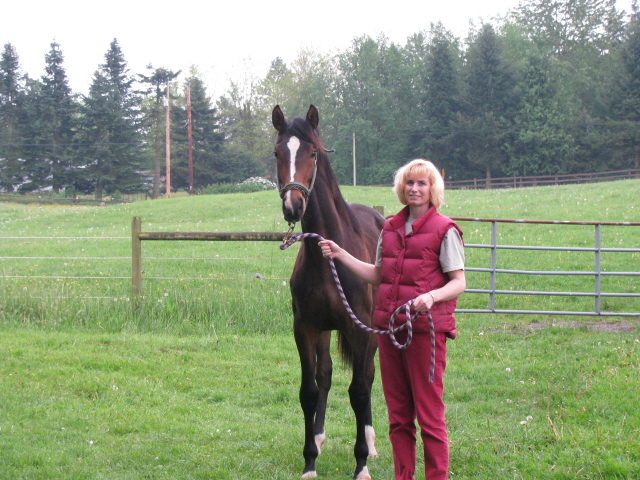
Liesl age 2

Liesl age 2

I have a horse with really bad behavior on the ground. I’ve owned her since she was six months old. It started the day I got her, she ran me over on the way out of the trailer and I’ve been wary of her ever since.

As an experienced horsewoman, I assumed I could apply all that I had learned so far to try and correct this behavior. I would say I was about 90% successful. She is mostly trustworthy, but that 10% of the time she isn’t, is extremely dangerous. She’s knocked me down many times. She doesn’t have a confirmed respect for personal space.

This year, I began to think there was no hope and I would have to sell her. I ride alone most days, and I was concerned she would knock me out and nobody would find me for days.

I had joined the American Quarter Horse Association, and began receiving their magazine. I was really impressed with the professionals in the Western discipline, they seemed to be very knowledgeable about how horses thought and reacted to people, and in reading the articles in the magazine I started to think differently about how I interacted with my horses.

I wanted to see this type of horsemanship in action. As a dressage person, I considered myself fairly open minded, but I think each discipline tends to think of itself as ‘all wise.’ I was so frustrated with my horse I decided I had better drop that attitude or this problem wasn’t going to get solved. I decided to travel to Oregon and see a Clinton Anderson clinic.

Those two days blew my mind. Watching him work with the horses was amazing. He spent a lot of time talking to the audience and really giving us a thorough view of how the horse’s mind worked. I wasn’t sure how to apply it to my riding, but I could definitely apply it to my ground training. I took so many notes I ran out of paper and had to write in the margins of the program.

I purchased a rope halter and lead, and the stick he uses for what he refers to as his Method. I started to work with my horses based on the notes I took at the clinic; my dressage horses learned to stay out of my space, yield to pressure, and even do rollbacks! I felt like I had been given the key to the secret horse training society.

My mare can now be safely led to and from the arena with no problems. She is calm and can be handled by anyone. She also had trouble loading into the trailer, but he had a technique for that too. I was grateful for it when I went on a three day road trip to California and halfway there she decided she didn’t want to get on the trailer. I knew exactly what to do.

They say there is no teaching, only learning. Now I believe it. I can learn something from anyone, and sometimes the learning comes from unusual sources.  I had to be willing to change my mind and admit I was wrong. Because I can do that, I can get better. It is a hard thing to do, but the rewards are great.
THE LITTLE QUARTER HORSE THAT COULD

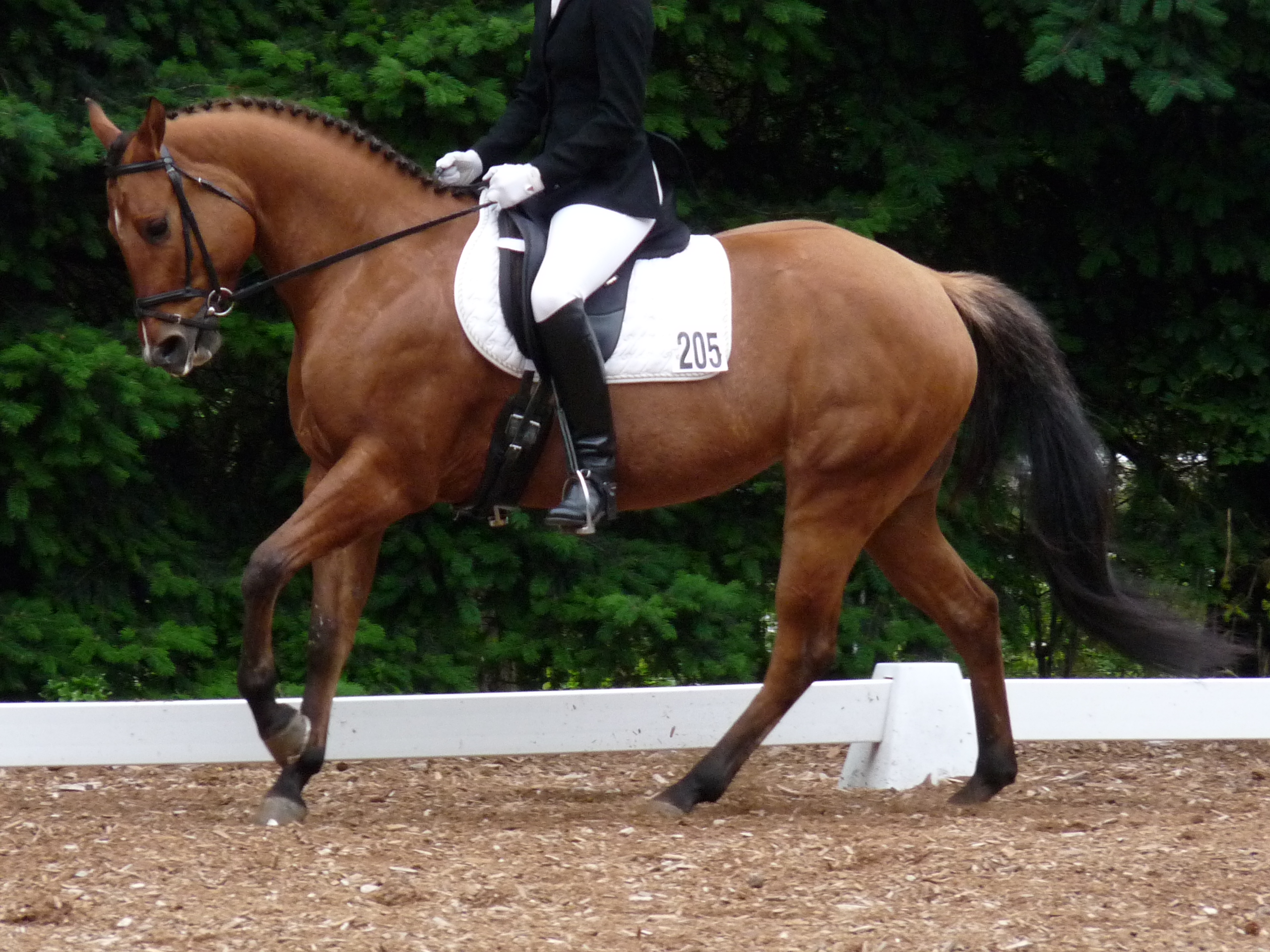
Justine 20101

Justine 20101

At the end of 2009, one of my horses colicked and died. She was a beautiful eleven year old Westphalen mare, and I had imported her from Germany in 2003. It was tragic, but fortunately happened quickly; it came on so fast there was no time to transport her to the clinic for surgery; she died within a few hours.

I was devastated, but with horses, in order to experience the triumphs and happy times, you have to be prepared to accept some of the difficult times as well.

I only keep two horses at home, so my other horse was left without a buddy. I decided to find a companion animal, nothing fancy, but something I could train and perhaps sell later on. I wasn’t too concerned about having another competition horse; any time spent in the saddle translates to more knowledge.

I looked around locally, and nothing stood out. My friend mentioned she had a Quarter Horse that was currently in reining training, and the horse didn’t show talent for it. She was going to bring her back home and just put her out in pasture. I decided to have a look to see if she would suit me.

She arrived at my house, and my first thought was how pretty she was. She was also very small compared to my warm bloods, but being a Quarter Horse, she was wide-bodied and even though I am 5’7” she was a good fit for me.  She was four years old at the time. Her name was Justine.

I started riding her and immediately noticed something special about her. Now I didn’t have high expectations for her. She was downhill built and moved like a sewing machine. But she was so sweet and willing, and I found myself looking forward to coming to the barn because every time she saw me she nickered loudly. And wow, what a quick learner she was! At age four, I had her doing all the first level dressage moves in a few months. Her canter was a highlight too, like a rocking horse.

Again, since I only had the two horses at home, I decided to bring her along to the shows with me. She was for sale, as her owner was having health problems and couldn’t keep her. So I figured getting her out and showing her would help with the sales process.

She had an amazing year. She almost always scored in the 60’s, and placed in most of her classes. She would go toe to toe with fancy warm bloods and hold her own. My other horse showed in the advanced classes, and preparing for those would stress me out. With her, I could just relax and have fun. It was a nice contrast from the pressure I normally felt when I showed.

She helped ease the sadness of losing my other horse. I was so amazed at how she tried, she never let me down. She didn’t have the natural talent of the warm bloods, but she would put 110% effort in every time. She belonged out there.  I try not to be overly dramatic, but it was almost like she had been sent to me for a reason. I never pondered that too much, all I knew was that I liked her and she brought me joy.

At the end of the season, I had another horse I brought into the barn to start, so I sent Justine back to her owner. I was satisfied with our season together, and thought it was time for both of us to move on.

Justine came back into my life a little over a year later. Another chapter began, and I will share that story in future posts.

TIPS ON TRAINING NEWLY HIRED ACCOUNTANTS

Congratulations! The business is growing and you need to hire more people. I will assume you’re past the screening process and have hired your ideal candidate. The problem is they have little to no experience. Either they are just out of school, or perhaps have experience in areas other than accounting. Here are some ideas on setting them up to succeed.

Unless you have other experienced staff, most of the training responsibility will fall on you. One of the best ways to start is to give them a relatively straightforward task. An easy way to do this that won’t require a lot of your time, is to have them prepare reconciliations or work papers that have already been done. For example your prior month sales tax returns, or financial statement work papers. They can compare their work to the prior month. If they have questions, have them prepare a list and you can schedule a time to go over it. This allows them to go at their own pace and learn by doing.

Another good way to get new hires started is cross-training with other departments. A staff accountant can pair up with an AR or AP clerk for a day. I like this because it gives your current staff a chance to learn effective training skills, and the new person will become familiar with your systems and other aspects of the company. It is also beneficial to have as many people as possible trained in data entry. There are always times when the volume increases, and there are not enough staff. The ability to have the extra work done internally is more cost effective than hiring temporary staff.

I want the people that work for me to understand that every task in accounting is potentially theirs.  Yes, they may get promoted and have additional responsibility, but if something needs to be done, they may “get the call”.  People need to understand that to work efficiently, sometimes you have to do things that aren’t as fun, or not as sophisticated. I like to look at it in terms of helping someone else; if AP needs help with their filing, I’ll do the filing, even if I’m the Accounting Manager. That’s the kind of attitude you want to instill in your employees, and the best way to do that is to lead by example.

After about a month on the job, ask your new employee to start documenting what they do every day. Once you have a week’s worth of documentation, review it, and then ask them to draft a procedures write up of their job. This assists with documenting internal processes and gets them thinking about other tasks they might enjoy doing.

Some people are happy to be told what to do; others are more aggressive and will seek out new opportunities. Find out what type of person you’re dealing with as soon as you can. One is not necessarily better than the other, but you can assign tasks based on skill level and attitude. For example, someone that is more of a follower will be suitable for repetitious work, like data entry, filing, or collections. Someone more aggressive will learn those things, get better and faster at those tasks, and end up with a lot more free time in the day. You want to be ready to fill that time with productive activities. You might consider having them start on one of those special projects that are sitting on your desk!

The common theme of these techniques is building teamwork. They should understand no task is too big or small. Let them know they will be recognized for making the department more efficient. Find out their strengths and use them to your advantage. Discover their weaknesses, and find ways to help them be stronger. In helping them build skills, you build yours as well.

TRUST YOUR INSTINCTS

While accountants always like it when things balance to the penny, we also consider materiality. For example, if your bank reconciliation is off by $20, and the account balance is $600k with millions flowing through it every month, it makes more sense to write off the $20 and move on with your life. I do it all the time. It allows me to focus on more pressing issues.

There are times though, when I see what appears to be an immaterial amount, but something about it bothers me.  Between sales, property, and income taxes, I file over 1,000 returns each year.  If I chased down every penny nothing would ever get done. However, when reconciling sales tax accounts, it really makes no sense for the general ledger not to tie within pennies of the subsidiary. In most cases the subsidiary is another software program that calculates the taxes on your invoices. In a perfect world, these systems communicate with each other seamlessly.  Since our world isn’t perfect, things happen.

Last month my general ledger and subsidiary were off by $17. The tax owed was $80k. But I was bothered. There was no reason for it to be off. I put my detective skills to work, it took about an hour, but I figured out that the software system was incorrectly posting a credit memo; the credit went to a different state than the original debit. Without getting into all the fun details, suffice it to say that this hour spent resulted in a reprogramming of the sales tax program to correct a systematic error that would have continued to occur. If I didn’t investigate $17, the next one could have been thousands, or over time it could have added up to even more than that.

Today I received an email requesting a resale certificate for a 3rd party shipment. The wording of the email was confusing; I read it quickly and thought I knew the answer, was about to hit send, then I felt again like something was wrong. I read the email a few more times, and determined there was a misunderstanding of sales tax law. As part of my investigating, I uncovered another problem.  I determined that a sale had been sourced to an incorrect state, no tax had been collected, and it was a material amount. The error I found was only thinly related to the email, but being bothered, I spent the time.

Never feel bad about spending extra time to investigate the details on something that just ‘feels wrong.’ You could uncover larger problems and solve them before they cost your company a lot of money. In communicating these issues internally, you show expertise and leadership. It also showcases your problem-solving and decision-making abilities.

Spending this extra time develops what I like to refer to as ‘the gut instinct.’ It will get faster and easier to glance at something and know that it doesn’t seem right and needs further analysis. Being able to react quickly with gut instincts is a valuable business skill. Never waste an opportunity to practice it – that $17 could change your life!

THINK LIKE A MENTOR

You may not know it, but you are influencing others all the time. I remember being at a horse show and talking to someone I’d known for about 20 years. We reminisced on what we were doing all those years ago, and she told me how she and her friend would always watch me ride my dressage tests, that they were so impressed with my riding and my horse. At the time, I was one of the only people showing in brown tack, and her friend was inspired by that and encouraged to use her brown tack too. This was over 20 years ago, and I never knew this.

In talking with someone else I’d recently met, she told me she’d always shown horses, but kept to herself; however she remembered me vividly, complimenting me on my riding and that she could tell how hard I worked, and couldn’t believe I wasn’t a professional. This is someone who I had been around for many years, and never met, and yet she knew so much about me. I was honored.

I meet quite a few people on the show circuit, I like to make new friends and encourage people to learn more about dressage. My mom called to tell me that her friend had met some young girls at the grocery store, mentioned that I rode, and told them about some success I had at a recent show.  The girls said they weren’t sure if they knew me, and walked away. A few moments later they came back and said that yes indeed, they did know me, they had even seen me at that particular show, and that I was so nice to them.

Even though this had just happened, I couldn’t remember interacting with those girls. But it made me so happy to know that I had left a positive impression. I try to always have a smile on my face and be ready to lend a hand. Showing can be stressful, and I’ve had my share of it. If someone forgets a piece of equipment, needs a towel fetched, or a test read, I try to be there.

It is very similar in business. You are always influencing those around you. If you are a manager, it is important to display a kind and helpful attitude toward the people you manage. It can literally change their life. Many times I would hire someone with great expectations, and for whatever reason, they would underperform. I felt responsible to help them, after all I decided to hire them, and I was ultimately responsible for the outcome.

I would meet with them, and come up with a progress plan, with actual goals they had to accomplish. It was important to do this in a non-confrontational way. I didn’t want to lecture them, I asked questions to determine the source of the problem and then it was up to me to take steps to fix it.

Whether this is more difficult than simply firing the person and moving on is hard to know. What I’ve found is that by developing an action plan and having regular meetings to discuss progress, one of two things can happen. They either improve, or they realize this job isn’t for them and look for another job.  This will happen in a relatively short period of time, normally 2-3 weeks.

I’ve rarely had to fire anyone.  If they start performing up to standards, I am right there to compliment them on their progress and increase their responsibilities. If they don’t, they start thinking about their skills, abilities, and goals and that motivates them to make a change. Leaving their current job might be the best thing for them, and it’s even better when they make the decision on their own.

When someone comes into my office and announces their resignation, but they are glowing with pride at finding a new job that fits what they want, it is good for both of us. Even though it didn’t work out for me, they learned valuable skills that will serve them later. It is a good feeling to know you contributed to a positive outcome for someone else. And then you can move on to your next opportunity.

HORSES TAUGHT ME HOW TO REALIZE SUCCESS IN BUSINESS

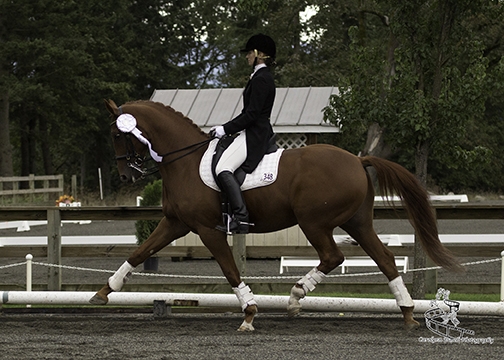
2013 Region 6 Championships

2013 Region 6 Championships

For as long as I can remember, I’ve loved horses. I think I’ve ridden a horse almost every day for the last 30 years. When I was a kid I would go to the barn and hang out all day, hoping someone would let me ride their horse. Even when I had my own, I was still begging people to let me train theirs. To me, there’s nothing better than being in the saddle.

The last 20 years I’ve spent riding dressage horses. It can best be described as ‘horse ballet.’ This is a labor-intensive and largely unrewarding sport. It takes 5-7 years to train a horse from basics to the Olympic level of Grand Prix. Most horses don’t make it. You really have to pursue dressage because you love it. They say it takes 2 lifetimes to achieve a real understanding of dressage, and I believe it. Whenever I think I know it all, something comes along and changes it, brings me back, makes me feel like a beginner again.

The only reason I pursued a business degree, and became a CPA was because I thought that would be a well-paid career that would allow me to pursue my passion of riding. It has rewarded me with the financial means and flexibility to follow my dreams.

I approach my business career the same way I approach my horsemanship. I always strive for excellence. Early in my career, I was hired on as an accounting clerk at several different private companies. The accounting departments would be large when I started, and then as time went on, people left. They weren’t replaced.  I picked up their job duties, produced outstanding results, and earned promotions. I managed to work the same amount of hours, sometimes even less.

My superiors would notice. I wasn’t always rewarded monetarily, but they were very flexible when I asked for time off to ‘do my horse stuff’ and just told me ‘whatever you want as long as you get your work done.’  It meant so much to me. I always felt I was fairly compensated for my work, I was doing what I loved, and I thought life couldn’t get any better.

Over time I’ve come to recognize my superior organization skills as a valuable asset.  I hope to use this blog to share some of my experiences, usually through a story about my horses. Accounting tends to be dry and technical, we like our lists and our procedures. I want it to be dynamic and fun, and I want to help people become more organized so they also have the time to pursue their passion.

My horses have brought me so much joy and contentment in my life. Of course there are heartbreaking setbacks, and times when I get tired and want to give up, but I keep on. It is truly something wonderful.