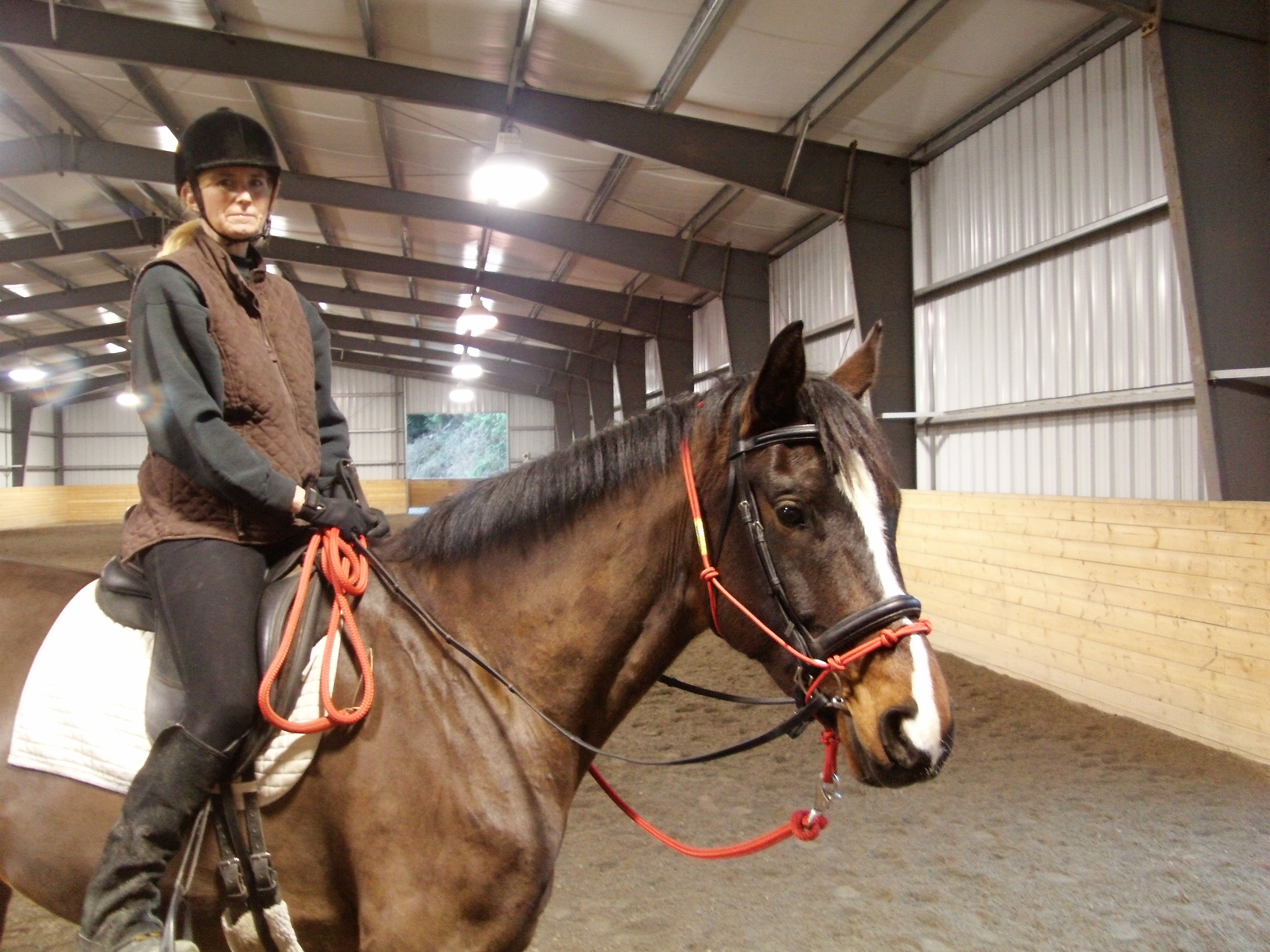
HOW CLINTON ANDERSON’S METHOD HELPED ME CORRECT A BEHAVIOR PROBLEM WITH MY DRESSAGE HORSE

DCIM100MEDIA


I was reminded once again of the hazards of equestrian activities a few days ago. My horse fell on me.

She had been giving me some trouble for a few days and it was getting progressively worse.  I was familiar with this bad behavior, as she had done it before. It had been over 6 months since the last incident so I thought I had trained it out of her.

The problem was her reaction to the leg and spur when I asked for vertical flexion (giving in the poll). She does find it difficult, but instead of resisting, she slams on the brakes and starts violently throwing her head around.  I ride her in a thin loose ring snaffle, but when she has resistance on her mind, she’s so strong she can rip the reins out of my hands.

On this day, she stopped, and started throwing her head around. I bent her nose to my boot and she started to go sideways.  I could feel her losing balance. I thought some sense of self-preservation would kick in and she would either stop or go forward. Instead, she pulled her head down and sideways, her front leg went straight out, and down she went.

It felt like slow motion, and she initially went down straight, like a camel. It gave me time to get my feet out of the stirrups. By the time she was all the way on the ground, she rolled slightly sideways onto my leg, but I was able to pull it free.

Her ongoing difficulties caused me to search for answers in unusual places. I’m most familiar with dressage training, but none of the techniques I tried on her worked.

I found the answers at a Clinton Anderson demonstration. He refers to his training techniques as The Method. I found the groundwork very effective and have been working my horse using his Method for about a year.

I was glad for it on this day. I didn’t want to get back on, so I did various groundwork exercises. After she was relaxed and listening, I got back on asked her to go forward on a loose rein. She complied and I ended the session.

I needed a way to translate the ground work to under saddle. The next day I asked my husband to help me. I put the rope halter on over her bridle, got on, and had him do the groundwork. She is trained to follow the lead, so whenever she got stuck, he would pull her head to the inside and point with his arm in the direction I wanted to go. If she didn’t respond, he would swing the stick.

This worked great, as long as she knew he had the line. The minute he took it off, she stopped.

I decided to leave the line on the halter and hold it myself. That did the trick. If she stopped and refused to move, I would pull her head slightly to the inside, and she would follow the lead.

After a few minutes, she was pretty solid and I could catch her before she stopped and essentially prevent the behavior.

The video shows the second day. I had my husband help me again. You can see at these certain points in the video where she stops and I work through a few different things. Initially I thought if I yanked the line it might help her focus, but I could see that after about a minute it wasn’t working.  Pulling her head to the inside was the most effective. Although the stopping never went away entirely, at least I had a way to deal with it.

Most people would say a horse that reacts badly to the leg should be made to go forward. I would say that too.  I normally would swallow my fear, put the reins in one hand, and either use a long jumping bat or spank her with the long rope. The problem is she shuts down, and if she is irritated with the bat or the long rope, she will either buck or swing her head and pull the reins out of my hands. The head swinging is what caused her to fall before.

I’ve learned that sometimes being patient and non-confrontational is the best way to handle her. Each horse is different, and if I do something that doesn’t work, I have to admit that I was wrong and try something else.

I included another video to demonstrate some of the groundwork.

https://www.youtube.com/watch?v=xq0sB5eXVZ0 Liesl – riding with rope halter and 14 ‘ lead

https://www.youtube.com/watch?v=noS8ivJ0I-U Justine – groundwork exercises
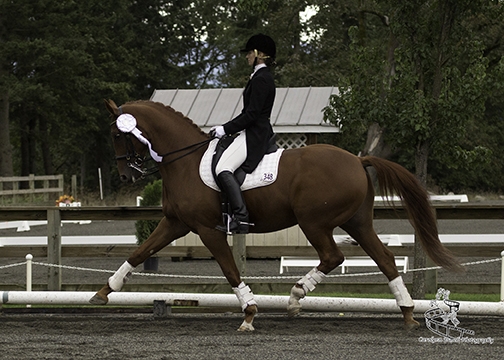
DRESSAGE CAN’T BE TAUGHT – IT MUST BE LEARNED

This is specific to dressage, as I am a dressage rider.

I’m not aiming this post at an absolute beginner, who would require teaching on basic horsemanship and position skills.

This is directed at intermediate level riders. These are riders with enough skill to control their horses and deal with most behavior issues.

If you are afraid of your horse, or are just starting out, yes you need a trainer. But if you are trying to learn the nuances of dressage, unfortunately it is a learned skill. Nobody can teach it to you.

I find that teaching someone how to ‘ride dressage’ is difficult if not impossible. The reason is that skilled dressage trainers rely on feel and timing to train their horses to respond. Feel and timing can only be learned by doing, including hours and hours of repetition.  Since we are dealing with an animal, this limits the amount of time you can spend in the saddle developing these skills.

I read a book called Mastery by Robert Greene. In the book, he discusses how much practice it takes to truly master a skill. Some say 10,000 hours, others say up to 20,000 hours. So if you only ride one horse five days a week, that’s 240 hours a year at best. Two horses brings you closer to 500 hours. So for horse riding, at that clip, it would take 41 years to master. Of course nobody ever masters dressage, it’s impossible. But it’s easier to do if you have balance, feel, and timing, and you’ll only get that by riding.

So many people are looking for some magic dressage success formula, like if you just uncover the secret key, you’ll be a success, win at the shows, and be able to train horses with ease. Or they think they just need a fancier horse and then they will be on their way.

The truth is, yes, all of that will help. Trainers will help you see things differently, and find more effective ways to train the movements. Talented horses find the movements easier and learn them faster. But so many people forget that they are also part of the equation. If you don’t ride well, the horse will never reach its potential.

I go out to the barn every day and ride without fail. I even had three horses for a while. I never wanted three horses, I even told myself it was impossible to ride three horses and keep a day job.

But I managed to do it because I saw the bigger picture. That third horse was increasing my time in the saddle. Hour by hour, day by day, weeks to week and month to month, I was adding to my knowledge base. That’s why even when I was tired, it was cold out, or I just plain didn’t feel like it, I still rode. Being excellent at something is quite a reward, no matter what sacrifices you need to make.

The problem when you rely on a trainer is that it shifts your attention from you getting better, to finding a solution outside of yourself to get better. This will never work out.

Whenever I relied on trainers, it took something away from me. I find dressage to be unique to each person, everyone has their own flair. It might be right, or wrong, that’s really not the point. The point is it works for them. If you want to reach the pinnacle of achievement you may have to let go of some of your wrong habits. Whenever a dressage trainer would dismantle my entire system, I would get upset. Then I would try to embrace their vision for my riding. I eventually learned that was a huge mistake. I had to be smart enough to know what to take, what to discard, and what simply wasn’t going to work, right or wrong. I have to work so much on my own I can’t allow my training to become frozen because I’m trying so hard to be right.

I have position problems and I’m grateful for the many people that have taken the time to relentlessly tell me how wrong I am over a period of days until it’s drilled into my head. I can take that back home and keep it up. Yes, it’s hard without someone harping on you every day, but you have to ultimately take responsibility for improving, and it’s not just practice, but ‘perfect practice’ The fact that I could be potentially wasting my time learning a bad habit is enough to scare me straight.

A recent clinic drove this concept home. I was told that yes I needed to practice sitting up straight and not leaning back, but there was no way I would get enough repetitions just practicing in the saddle. I was told that when I was at work I was never to lean back in my chair, to sit on the edge of it always straight. That doesn’t seem difficult until you try to do it. I was exhausted after the first hour. But I kept my awareness up. Every once in a while I have to relax and lean back in my chair, but it feels like a very strange thing to do now.

The reward for all of this hard work and sacrifice is to become truly excellent at something, to master it. I love to go ride now, because I know each day I have a plan, I have the skills to get there, and I’m not afraid to try new things or make mistakes. That makes every day a pleasure, and I’m grateful for the chance to try.

HOW TO KEEP MOTIVATED TOWARDS YOUR GOAL – DRESSAGE EDITION

I pursued a goal that took me twenty-five years to achieve. I feel that gives me some perspective on self-motivation and how to keep going in the face of overwhelming odds.

My goal was to show Grand Prix dressage. Whether I trained the horse myself wasn’t part of the goal, but the reality was that trained Grand Prix horses are expensive, so by default I had to train one myself. If someone would have told me it was going to take twenty-five years, I may have reconsidered. But nobody can know the future, and this was my dream. I couldn’t let it die.

So I kept on going, even though setbacks were unending. The specifics aren’t important, and would take too long to record here anyway. The thing I remember most is that even when I absolutely, positively wanted to give up many, many, times, and even decided it wasn’t worth all the sacrifice, somehow I kept convincing myself there was no other option but to go on. Following is a list of techniques I used to keep me going:

  1. Habit. Once a habit is established, it’s really hard to break it. We know this is true for things we shouldn’t be in the habit of doing, like smoking or eating too much. It applies just a well to positive habits. I think about NOT doing the thing I’m supposed to be doing.  Then I think, that’s a lazy way to be, it’s just a few hours, do it. I noticed if I got sick and took a few days off, all of a sudden it became easier to take even more days off. So you can’t have excuses.
  2. Step goals. Every day I decided what I would try and teach my horse, or what I wanted to improve on. If I really didn’t want to ride I would decide to make the session a little shorter and get this or that done. I found once I tacked up the horse and made the long walk to the arena, it wasn’t much extra effort to have a normal ride.
  3. That leads to momentum. Habit gets you there. Once you have the step goals, you make a little bit of progress, and you see your bigger goals coming into view. Unfortunately they can come into view and disappear just as fast.  What I’ve found was that like a slippery slope, once I had momentum, even if I slipped and fell, I didn’t fall all the way to the bottom. I landed on some ledge and I was still closer.
  4. Setbacks – this is a tough one. You just have to be mentally strong, and your habits will help you. Your habits will hold you up if your mental will gives out. It is difficult, and your inner voice will tell you to quit. What I say is that if I quit, I won’t get to that wonderful place. Something wonderful is going to happen, it will be better than I can even imagine, but if I quit I will never know it. Mind you, that wonderful thing was decades away in my case, but the habits kept me on.
  5. Loneliness – the road to excellence is a lonely one. You won’t find many kindred spirits. They show up here and there along the way. It’s unlikely they will be with you on your entire journey.  If you’re not careful you may be lulled into believing that where you currently are, is the best it can be. Staying where you are never leads to anything but emptiness. I would rather be lonely than empty. It is a sacrifice, but one worth making. If I didn’t make it, I wouldn’t be able to tell you about it.
  6. Choices – we all make them. Sure you can choose to give up, not pursue the goal, or change the goal. Each person knows what’s right for them. Be sure you ask yourself why and thoroughly understand the reasons. If you’re just tired, that is not a reason. You will regret giving up for that reason. You will never reach your potential. As far as I’m concerned, that is a waste.

Reaching my goal was pure joy – a huge reward. But remember, even when you reach your goal, it isn’t over. You’ve gotten to a new and better place, and now you can set your sights even higher. That’s the beauty of it.

It’s never too late to start the journey to your true calling. It doesn’t matter how old you are, or the mistakes you made in the past. Today is a new day to take the first steps towards your dream. It doesn’t have to happen overnight, but it will never happen unless you do something to change. START TODAY!

http://youtu.be/96N5jEomNaI

DRESSAGE TRAINING USING BEND

Today I’d like to share some video of my horse Liesl. She’s now seven years old and as I detailed in prior posts, it has not been easy with her.

About a year ago, after I learned of Clinton Anderson, and studied his techniques, I realized I was trying to make her change to fit my method. I was thinking in a very narrow way. She wasn’t responding to me in a positive way, so there must be something wrong with HER. In fact, there was something wrong with ME.

I needed to change my approach. To do that I needed to understand why she acted the way she did. Now of course I can’t really know the operation of her mind, but I tried to break it down into smaller pieces and not assign emotions to her actions.

The techniques I learned really helped me unlock her potential. Whenever something isn’t working, I don’t try to force it. I take a step back and think about why she might be acting the way she is. What can I do to convince her that it’s easier to do what I want?

One of the techniques Clinton uses to supple his horses is bending left and right, both on the ground and under saddle. The key is to bend the horse, then hold the pressure until the horse releases. It’s not just sawing the neck back and forth.

When I first tried it with my horses, I couldn’t believe how stiff they were. Neither one of them could bend more than slight sideways. It took weeks of daily practice until they could easily swing their necks from side to side on the ground.

When I started it under saddle at a standstill, the immediate reaction was again stiffness. I couldn’t get much bend. The video is taken after a few weeks of practice.  Liesl actually tries to beat me to each side, I’m barely touching the reins and she offers the bend.  The video also shows the desensitizing to the stick and string.

When they are moving it’s harder to feel the give but I would describe it as almost like a hollowing, rubber band feel in their neck and body, and they lighten in the mouth. This horse was so stiff every time I asked for the bend in either trot or canter she would revert back to her most common resistance, which was stopping.

At that point I had to ask consider the possibilities – was it impossible for her, or was it too difficult and she wouldn’t try? Since she can’t talk, I assumed that yes it was difficult, but that I should still ask, and accept less. After a little trial and error, I found the place where she can try and feel successful.

The longer video shows this work in the canter, and I’m incorporating the half-pass. She’s still very stiff, so I don’t ask for perfection, but I do want extra bend in the sideways to help supple her.

She’s also just starting her flying changes. They are still awkward but I’m not too concerned if she changes before I ask, or if she changes a little bit late. I’m just trying to give her the idea.

I’m finding that this bending concept really helps me to understand why things go wrong, how to deal with it, and also to be accepting of less as long as they try. It makes for a pleasant ride every day.

I work on my own and make many mistakes. I’ve learned not to be afraid of the mistakes. Horses are very forgiving, and I’ve been able to undo more of my training errors than I believed possible.

I’m so glad I found this technique and didn’t give up on this horse. And I never thought I’d say that I enjoy riding her. What an amazing transformation. It never would have happened if I was too stubborn to admit I was wrong, and change.

Video links are below:

http://youtu.be/Gfi5zUlBH4c
http://youtu.be/835MPOUW9xo

STRENGTHEN YOUR (MENTAL) CORE

As I wrote in prior posts, I have a horse that is difficult. I’ve learned techniques to manage her behavior, and we steadily make progress. She is now seven years old and I hope to show her 3rd level dressage this year.

This horse does relapse back into bad behavior. So not all the techniques I’ve learned work 100% of the time. At first I tried to follow them to the letter.  I told myself I must not be doing it right if it doesn’t work. But on my own, with nobody helping me, I found this wasn’t productive. It was wrong-headed thinking. I had to make a decision about where to go with the training.

I don’t think I can ever sell this horse. Her behavior can be unpredictable, and I feel it would be dangerous to pass her on to someone not skilled in dealing with it. Someone who could deal with it would probably get frustrated and turn to methods not conducive to making the situation better. More than one person told me she just needed to be beaten.

So as I think about it, what keeps coming into my mind is that I am responsible for her. I’ve had her most of her life, so whatever her problems, I had a hand in making them. No, she isn’t fun to ride sometimes, and when things are hard, it’s easy to want to give up. I say to myself that I deserve better. But so does she. She needs me to get better so she can reach her potential.

I accepted my role in her life. That it wouldn’t be easy, that it would be frustrating, and that I couldn’t seek professional help because people were so critical of my solutions and wouldn’t allow my ideas in.

Sometimes in business, you are in situations you don’t want to be in, and it would be easy to say, it’s too hard, it’s too much work, or my personal favorite, it’s not fair. But you have to ask yourself if you are the best person for the job. Could someone else do it better, or are you uniquely qualified? Will someone else even be willing to do it?

If not, then you must take it on. You must do it even if you don’t want to.  You must do it even if you don’t see any reward beyond yourself, even if it won’t get recognized. By experiencing this on your own, without outside influence, your core will become stronger, and this will intersect with an unknown opportunity in the future. This is the foundation for success.

DO THE OPPOSITE

I’ve been struggling with my Grand Prix horse the last few weeks. He is really tight and stiff in the back, and I have a hard time getting him looser in his canter. Since I work alone, I have to be self-motivated and try and come up with solutions. My first idea is to do the opposite of what I’m currently doing, just to shake things up. If I’m holding too tight on the reins, I let them long and loose. If I’m leaning back, I lean forward. If I’m kicking too much, I stop and just use light leg aids.

It is really hard to change yourself like that. My first reaction is to try and fix whatever happens when I do the opposite. That just sends me back to what wasn’t working, so I have to fight off that feeling. I try to stick with the opposite approach long enough to understand what is changing. Then I have to decide if I think it is enough of a change to warrant continuing on with it.

That is the problem in dressage. Changes can take days, weeks, or even months to manifest themselves. You have either been traveling down the wrong road and have to go back, or you picked the right thing and you’re closer to your goal. It is the waiting to find out that’s hard. And if you were wrong, you feel like an idiot for wasting all that time. I try not to let those feelings haunt me.  I learn a lot from my mistakes, it just takes me a long time to realize the learning.

I’m a member of Clinton Anderson’s No Worries Club. I really like it because he has a huge library of videos on his website that cover just about any problem you could ever have.

I went to the site and searched for dressage, and four videos came up. The first one featured a top dressage horse ridden by a professional, and the comments weren’t all that helpful.  The next three were a series with another dressage trainer. In one of the videos, Clinton put on a top hat and tails and rode the dressage horse. It was amazing. He is so humble and doesn’t take himself too seriously, even making fun of himself a little bit. He rode the horse really well, and clearly he’s an expert horseman. Watching that really buoyed my spirits.

I took notes and found that these videos gave me some great ideas for my own horses. Clinton is an expert at suppling a horse, and although it isn’t the’ dressage way’, it is extremely effective. I ended up having two great rides today. Thank you Clinton Anderson!

BE STUBBORN

I used to think I needed to train my dressage horses with someone regularly to make any progress. I’ve learned that it really depends on who you can find to train with. Once you’ve been riding for a while, you start to develop your own system. In dressage, there are plenty of opinions on what is right and wrong. Someone will always think you’re wrong and this can be a problem if you don’t recognize it.

The last few clinics I rode in actually made things worse for me. The instructors wanted to radically reconstruct everything I was doing. When someone tries to completely change you like, it makes you assume that everything you do is wrong. Maybe wrong to them, but not wrong to you. You can train incorrectly and you’ll get a result. It may not be the best result, but it is a result.

If you can find a kindred spirit, someone that connects with you, that allows your voice to be heard, then consider yourself very lucky. I had that for a very short period of time, which ended in 2006 with my mentor’s death. I look back on it now and I’m so glad I recognized what a gift it was to work with someone like that. He clearly knew more than me, but was humble about it. He told me he wasn’t God, and just told me what he saw. He said I was the trainer, and if he told me to do something that didn’t work, I was to ignore it.

Since he died, I’ve been searching for my next mentor. I’m still searching. I do learn from everyone I work with, as long as I can incorporate it into my system.  It fails when I try to embrace their entire method and abandon my own.  I second guess myself so much I become useless. This is something that must be avoided.

I don’t recommend working on your own for extended periods of time. But I will say this – it can work. It took me a long, long, time to train my first horse to Grand Prix. Even I didn’t think it was possible to do such a thing without a trainer. It was hard, frustrating, and I was off in the weeds more times than on the correct path. I pondered why it was that I managed to succeed, and I think it was stubbornness. I refused to give up in the face of overwhelming odds.

Of course I can’t rest – I’ve reached this goal and now I’ve set another one. I need to get better at Grand Prix. My horse is sound and relatively young (age 14). I still have days when I get frustrated, and tell myself to give up, but that’s one inner voice I am able to ignore. My other voice tells me to keep on, because if not now, when?  You never know what you can accomplish if you give up. That’s why I don’t!

HORSES TAUGHT ME HOW TO REALIZE SUCCESS IN BUSINESS

2013 Region 6 Championships

2013 Region 6 Championships

For as long as I can remember, I’ve loved horses. I think I’ve ridden a horse almost every day for the last 30 years. When I was a kid I would go to the barn and hang out all day, hoping someone would let me ride their horse. Even when I had my own, I was still begging people to let me train theirs. To me, there’s nothing better than being in the saddle.

The last 20 years I’ve spent riding dressage horses. It can best be described as ‘horse ballet.’ This is a labor-intensive and largely unrewarding sport. It takes 5-7 years to train a horse from basics to the Olympic level of Grand Prix. Most horses don’t make it. You really have to pursue dressage because you love it. They say it takes 2 lifetimes to achieve a real understanding of dressage, and I believe it. Whenever I think I know it all, something comes along and changes it, brings me back, makes me feel like a beginner again.

The only reason I pursued a business degree, and became a CPA was because I thought that would be a well-paid career that would allow me to pursue my passion of riding. It has rewarded me with the financial means and flexibility to follow my dreams.

I approach my business career the same way I approach my horsemanship. I always strive for excellence. Early in my career, I was hired on as an accounting clerk at several different private companies. The accounting departments would be large when I started, and then as time went on, people left. They weren’t replaced.  I picked up their job duties, produced outstanding results, and earned promotions. I managed to work the same amount of hours, sometimes even less.

My superiors would notice. I wasn’t always rewarded monetarily, but they were very flexible when I asked for time off to ‘do my horse stuff’ and just told me ‘whatever you want as long as you get your work done.’  It meant so much to me. I always felt I was fairly compensated for my work, I was doing what I loved, and I thought life couldn’t get any better.

Over time I’ve come to recognize my superior organization skills as a valuable asset.  I hope to use this blog to share some of my experiences, usually through a story about my horses. Accounting tends to be dry and technical, we like our lists and our procedures. I want it to be dynamic and fun, and I want to help people become more organized so they also have the time to pursue their passion.

My horses have brought me so much joy and contentment in my life. Of course there are heartbreaking setbacks, and times when I get tired and want to give up, but I keep on. It is truly something wonderful.